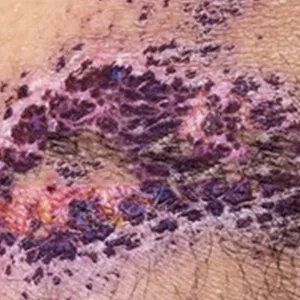
Whitlow is an abscess or infection in the soft tissue near a fingernail or toenail or a purulent infectious (highly contagious) disease of the skin affecting the deeper tissues that surrounds the fingernails (or toenails) and causing inflammation (or pain and small blisters [forms pus] on the affected region). It occurs if the broken skin comes in contact with the cold sores or genital lesions. It often resolves without treatment in 2-3 weeks.

Categories of Whitlow
1) Herpetic Whitlow – Its a condition caused by Herpes Simplex virus on finger or thumb. It is a painful Infection oftenly occuring on toes or nail cuticle.
2) Melanotic Whitlow – Its a melanoma beginning in the skin at the border or beneath the nail.
Causes of Whitlow
• Bacterial Infection on the fingertip.
• Herpes simplex virus Infection on the fingertip – Herpes Simplex Virus (HSV). HSV 1 and HSV 2 are common and highly communicable viruses. HSV 1 affects the face and may cause blisters on lips and can be spread through kiss or oral sex, while HSV 2 causes painful genital blisters and can be spread by Skin to Skin contact with infected genitals.
Risk Factors for Whitlow
• Career in a health care profession (such as dentistry or nursing)
• Herpes simplex virus 1 or 2 Infection
• Human immunodeficiency virus (HIV) Infection
• Injury to the finger with broken Skin surface
• Nail-biting habit
• Small children (self-inoculation with unwashed fingers)
Symptoms of Whitlow
Finger
• Burning feeling
• Development of small bumps or blisters
• Itchy feeling
• Redness, warmth or swelling
• Tingling or other unusual sensations in the hands
General
• Blisters or sores at other sites on the body
• Enlarged Lymph nodes in arms (near the elbow or underarm)
• Fever
• Red streaks on the arms (Lymphangitis)
Severe
• Confusion or loss of consciousness for even a brief moment
• High Fever (higher than 101 degrees Fahrenheit)
Potential Complications of Whitlow
Untreated whitlow can cause’s serious side effects (in very rare cases).
• Encephalitis (inflammation and swelling of the brain due to a viral Infection or other causes)
• Meningitis (Infection or inflammation of the sac around the brain and Spinal cord)
• Severe discomfort or pain
• Skin ulcerations and Infections
• Spread of Infection
• Tenosynovitis (Tendon inflammation)
Tips on the Prevention of Whitlow
• Avoiding chewing or sucking on your fingers or thumbs
• Avoiding direct contact with open herpes lesions (including cold sores or genital lesions)
• Avoiding nail biting
• Frequent handwashing
• Practicing safe sex (use condoms or dental dams)
• Using gloves and universal precautions when at-risk for contact with body fluids.
Home Remedies for Whitlow
• Lemon – Take a Lemon and make a hole into it, then insert the affected finger into the hole for about 10 minutes done twice (22) daily for quick healing.
• Magnesium Sulphate – Take a suitable anti-septic and clean the infected area, get a tube of Magnesium sulphate and apply a generous amount on the affected area and cover with Cotton wool or lint. Apply a bandage over the covering and it should be changed and repeated over a period of time.
• Rice flour and Linseed oil – Make a poultice from Rice flour and Linseed oil, then apply the poultice to the affected area for quick relief.
Aloe Vera Preparation for Whitlow
1) Slice the fresh Aloe Vera leaf in order to expose the inner succulent tissues, then squeeze the gel from the succulent part of the leaf.
2) Collect just enough gel for topical application on the infected Skin.
3) Using sterile Cotton wool, apply the Aloe Vera gel on the finger and allow it to dry on its own.
4) After about 20 minutes, rinse the Aloe Vera gel off.
5) Use the remedy twice (2) daily to help get rid of the symptoms of whitlow.
Coconut Oil Preparation for Whitlow
1) Coconut Oil has a tendency to solidify when exposed to low temperatures. Simply place some of the oil in a bowl, and then put the bowl in a warm Water bath to help melt the oil indirectly, effectively maintaining the structural integrity of the oil.
2) Once the oil has melted, dip the Cotton wool in the warm oil and dab it on the infected finger.
3) Let the oil dry on its own and repeat the procedure thrice (3) daily for best results.
4) You may also want to introduce Coconut Oil to your daily diet by using it to cook.
Fresh Garlic Cloves Preparation for Whitlow
1) Peel the Garlic Cloves and chop into small pieces.
2) Transfer the chopped Garlic and crush using a pestle and mortar.
3) After crushing the Garlic, you should end up with a paste that is easy to apply on the infected finger.
4) Use Cotton wool for the application process, doing so carefully to avoid cross contamination to other parts of the body such as the mouth.
5) The remedy may cause a burning sensation, but this is a small pRice to pay considering the immense benefits Garlic has on the body.
6) Let the Garlic paste dry on the Skin for 20 minutes.
7) Rinse the remedy off using warm Water.
8) Repeat the procedure twice (2) daily until the symptoms of whitlow are completely cleared.
Garlic Oil Preparation for Whitlow
1) Soak a piece of sterile Cotton wool in the Garlic oil for 30 seconds.
2) Squeeze a few drops of the oil on the infected finger and then dab using the Cotton wool.
3) Optionally, chop a few Cloves of Garlic and add them to Olive Oil in a pan. Fry the Garlic until it is browned (but not burned).
4) Strain the oil to get rid of the fried Garlic, and use the strained oil for topical application.
5) In addition to these remedy options, it helps to add Garlic to your daily diet as a preventive measure for recurrence in the future.
Licorice root Preparation for Whitlow
1) Mix equal amounts of the Licorice root powder with warm Water so as to create a paste.
2) Use sterile Cotton wool to apply the Licorice paste on the affected finger and let it dry on its own.
3) Use the remedy thrice (3) daily until the symptoms of whitlow are completely cleared.
Peppermint Tea Preparation for Whitlow
1) Steep the Peppermint tea bag in a cup of boiling hot Water for 5 minutes.
2) Set the teabag aside and let the tea cool before taking the refreshing drink.
3) Alternatively, refrigerate the used tea bag by placing it on a set of ice cubes.
Peppermint Oil Preparation for Whitlow
1) Soak a Cotton wool ball in the Peppermint oil for a few seconds.
2) Dab the wet Cotton wool on the infected finger. The oil has a cooling effect which comes in handy in eliminating the burning sensation experienced in the infected finger.
3) Apply the oil severally daily until there is a notable improvement in the condition of the infected finger.
Tea Tree oil Preparation for Whitlow
1) Dilute the Tea Tree oil by mixing it with the preferred carrier oil.
2) Soak the Cotton wool in the oil mixture and apply it on the infected Skin.
3) Do this severally daily until the Infection clears.
Treatments for Managing Whitlow Symptoms
• Analgesic can be used to reduce pain and Fever (if present).
• Anti-Viral Medications can be used to to prevent or manage the Infection (especially in individuals with frequent or severe Infections or compromised Immune Systems).
• Topical Anesthetics can be used to reduce local itching and pain on the fingers.
The affected finger should be:
• Bathed in a German Chamomile infusion for half an hour, several times a day. Afterwards an ointment for abscess is applied and then a clay pack.
• An old remedy mentions bathing the hand in Milk in which Garlic had been boiled for half an hour.
• If the finger is decomposing, a plaster of Linseed meal is applied.
• Should the swelling break, the finger is bathed in a warm German Chamomile infusion and a dressing with St.John’s Wort oil is applied.
• A mixture of Elder flowers, Fern Roots, Lesser Burnet and Marsh Mallow used in equal proportions is another household remedy.
• 15gm of this mixture is soaked in 1/2 litre of white wine overnight and boiled the next morning.
• The finger is bathed in this herb wine for 2 hours, then chalk powder is applied and the finger is bandaged.
Food Remedies for The Treatment of Whitlow


• Aloe Vera – Aloe Vera is one of nature’s most versatile remedy for the treatment of a myriad of Skin conditions (such as whitlow). Aloe Vera‘s healing properties go a long way in fighting off the herpes virus and acts as a pain reliever.
• Carrot – Use a Carrot poultice over finger or nail abscess. Grate 2 Carrots and warm them, then tie them in a piece of cloth.
• Coconut Oil – Virgin Coconut Oil has great health benefits for the body. The oil’s anti-viral properties help fight off the herpes virus as its lauric acid (one of the key oil components) is converted to monolaurin (a type of fat to which the anti-viral properties), while its capric acid compLiments its healing effects.
• Garlic – Fresh Garlic have excellent Anti-Microbial and natural Anti-Inflammatory properties helps as a natural treatment of whitlow. Its two (2) compounds (allicin and ajoene) have an anti-viral effect which helps to mount a response against the herpes virus.
• Licorice Root – It has immense health benefits as an ideal choice for the natural treatment of whitlow and contain glycyrrhizin whose anti-viral effects are able to fight off the herpes virus that is responsible for the Infection.
• Flaxseed –
• Psyllium – Psyllium husks are soaked in an infusion of Calendula (Calendula officinalis) makes an effective poultice for external use, drawing out Infection from Boils, abscesses, and whitlows (pus-filled swellings on the fingertips).
Herbal Remedies for The Treatment of Whitlow

Asian Poison Bulb

Lesser Burnet

Chamomile

Cypress

Elder Flowers

Fern Roots

Kigelia

Marshmallow

Peppermint

Sabah Snake Grass

Sodom Apple

St.John’s Wort

Tea Tree oil

Vipers Bugloss
• Asian Poison Bulb – Asian Poison bulb (Crinum Asiaticum) leaves are warmed, mixed with castor oil and applied as a bandage on the affected area.
• Lesser Burnet –
• Chamomile –
• Cypress – Its Resin has a Vulnerary action on slow-healing Wounds and also encourages whitlows to come to a head. It helps soothes cuts, sores, and Wounds.
• Elder Flowers –
• Fern Roots –
• Kigelia – Its a Skin toner/restorer and valuable remedy for Skin problems produced by bacterial and Fungal Infection (particularly sores and ulcers). The plants bark, leaves, stems, twigs or Fruits powders and infusions are particularly useful as a remedy for a wide range of Skin problems (such as cleaning and dressing flesh Wounds and open sores).
• Marshmallow –
• Peppermint – Its a handy home remedy for the natural treatment of whitlow, thanks to its excellent virucidal effects on the herpes virus responsible for the Infection, and also has a cooling effect on the infected finger, effectively soothing the pain and reducing the discomfort in the affected finger.
• Sabah Snake Grass – Sabah Snake Grass has anti-viral properties, thus commonly applied (in Thai folk medicine) onto viral lesions (or rashes on the Skin) to reduce the size of virus plaque and affect the intracellular activity of HSV-2. It has promising anti-HSV agents through some of its bioactive constituents (such as Polyphenolics, Glycosides and terpenes).
• Sodom Apple – Sodom Apple leaf paste/sap, root infusions (or the pounded Fruits) are rubbed externally into scarifications for washing painful areas, and the plants Ash is mixed with fat and applied as an ointment for Skin Infections and conditions (such as whitlow, ringworm, Burns, sores, rashes, Wounds, warts, carbuncles, ulcers and benign tumours).
• St.John’s Wort –
• Tea Tree oil – Tea Tree oil is an effective home remedy for treating whitlow and eliminating its symptoms (helps relieve the characteristic throbbing pain and mounts an attack on the herpes virus). Tea Tree oil must never be applied directly on the Skin to prevent Skin irritation, but mixed with carrier oils such as Jojoba, Almond, Olive and Vegetable oils.
• Vipers Bugloss – Vipers Bugloss herbal tea (a spoon of dried herb in a cup of boiled Water, 2-3 times a day) is administered as emollient and anti-pyretic (or applied externally in the form of fresh leaves poultice for healing and soothing). Its fresh flowering heads (when chopped up finely) can be made into a poultice for treating whitlows and Boils.