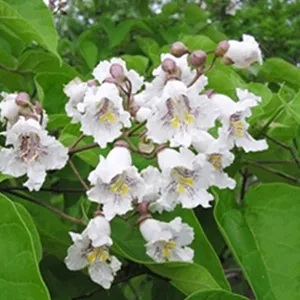


Catalpa is a deciduous ornamental shade tree growing to 65 ft (20 m) that produces dense clusters of white flowers in conical clusters and long seed pods, having large oval leaves in whorls of 3, and long thin fruits (bean pods), native to the southeastern USA.
They are hardy plants that require very little water, various species are often grown outside of their native regions (particularly for their decorative features).
Its cultivated in rich moist soils by the sides of streams and rivers. They are mainly used for their ornamental features, making excellent decorative plants for large areas (including yards and parks).
Plant Description
Catalpa is a small to medium sized, fast growing, moderately short-lived deciduous tree with a wide, spreading, round-headed crown that normally grows about 15–18m (49–59 ft) tall, with a trunk up to 1m (3ft) diameter.
The plant is found growing in rich moist soils by the sides of streams and rivers, Stream banks, gravel bars, road cuts, bottom land forests, and fence rows.
The plant grows best on open, moist, well drained alkaline and deep soils, but can grow across a range of moisture regimes once established.
The wood is of moderately light density (specific gravity 0.42 oven dry), with pale gray sapwood and grayish brown heartwood.
It has a faint, aromatic, non-characteristic odor and no characteristic taste.
It is ring porous, coarse-grained, soft, not strong, but very durable in contact with the soil.
Roots
The roots are fibrous and branches are brittle. Its juices are watery and bitter.Roots are Poisonous and should not be handled or composted.
Twigs
Southern Catalpa twigs are thick, stout, and brittle.Twigs are minutely Hairy and pale Orange to brownish-grey in color.
Many short crooked twigs and branches support a wide-spreading, irregular crown.
Lenticels are clearly present on twig surfaces, and are large, pale and numerous.
The terminal bud is absent and lateral buds are small (1/16 inches long), sunken, brown, and solitary with six overlapping bud scales.
Twig pith is solid and white in color.
Usually 10-12 vascular bundle scars are clearly visible in a circle-shape within the leaf scar.
Leaf scars occur 2-3 per node. Neighboring leaf scars on the same node are not connected by lines and there are no stipular scars.
Southern Catalpa stem periderm is light reddish brown to grey in color. Periderm on young trees begins smooth and thin, eventually flaking off into thin, narrow scales
Bark
Tree bark ranges from scaly to ridged, to blocky plates.On a mature tree trunk the bark may be from ¾ to 1 inch thick, light grayish brown in color, and broken into longitudinal, scaly, flat ridges.
On young tree seedlings the bark is thin and easily damaged by impact, or rodents.
Leaves
The large size and broad, heart-shaped leaves also make them great shade trees.
2-3 leaves grow from each node (an opposite or whorled leaf arrangement).Leaves are large, deciduous, simple, and broadly heart-shaped.
Leaf margins are smooth, entire or slightly wavy.
The leaf tip has an abruptly sharp point.
The leaf base is heart-shaped and can occasionally have two small basal lobes.
Leaves are connected to twigs with a long petiole that is about 3-6 inches long.
Leaves are 5-10 inches long and 3-8 inches wide.
Leaves are a bright medium green color and smooth on top, and paler green and slightly Hairy (i.e. with trichomes) on the underside.
Undersides of leaves are especially Hairy on veins, with leaf Hairs turning black by fall.
Leaves produce an unpleasant aromatic odor when crushed.
Leaves may scorch and drop during droughts.
They turn an undistinguished yellow in the fall before dropping.
They secrete nectar, a most unusual characteristic for leaves, by means of groups of tiny glands in the axils of the primary veins.
Flowers
Flowers of Indian bean tree are large, white, and showy, blooming just after leaves have expanded.Trees are normally cosexual (a tree having both sexual parts in one flower) with perfect flowers.
Flowers are slightly fragrant, and 1 to 1.5 inches long and wide.
Flowering occurs from June to July in large upright, pyramid-shaped flower clusters 7-11 inches tall and wide.
Flowers are predominately white with a bell or tube shape.
Each flower has a variety of yellow to Orange, and purple to purple-brown lines, markings, or spots on its inner surfaces.
Flower tubes each have five unequal, rounded, and fringed lobes with two upper lobes larger than the three lower lobes.
The lowest or bottom-most lobe is not notched.
Flower has two visible ridges and presents two rows of yellow-orange spots (or stripes) as well as many purple spots on the inner side of the flower tube and lower lobe.
There are two fertile stamens present. Flowers are good for Raw Honey production.
Fruit
Fertile flowers are followed by long, slender, thin-walled, pod-like, two-celled capsules which dangle from ends of twigs.They look like long, thin, cylindrical pencils or cigars about 20–40 cm long and 8–10 mm diameter.
Fruits are initially green which dries to a brownish color and eventually splits along two lengthwise seams.
Fruits mature by October and are held on a tree until spring.
Inside each Fruit are many papery, thin, flat seeds with two long-pointed wings which have tufts of fringe Hairs on each end.
Seeds
Seeds with wings are 1-2 inches long and 1/4 – 1/3 inch wide.They have a light brown coat and wings rounded at the ends terminating in a fringe of short Hairs.
There are approximately 20,480 seeds per pound.
Seeds which are collected after overwintering in the mature seedpod have a higher germination rate than those collected in the fall and stored.
Growing a Catalpa tree from seed
You can grow a catalpa tree from cuttings, but it’s easier to grow them from seeds.
1) Collect the pods after the leaves fall—once the pods are sufficiently dried but before the seeds have fallen from open pods and store them in a cool, dry area.
2) When you’re ready, the seeds may be separated from the pods and placed in packets.
3) Plant the seeds in a pot with good drainage as it best grow with low moisture. Fill the pot with potting soil (pH 5.5–7) and place a few seeds on top.
4) Lightly cover the seeds with more potting soil (no more than 1 inch in depth).
5) Lightly water the seeds, and place the pot in a shaded area (with mild temperatures of 60–70 degreesF). The young seedlings won’t be able to handle the intensity of full sunlight.
6) Continually monitor the seedlings and keep the soil moist but not soaked.
7) Within a couple of months, the seedlings will be a few inches tall with 1-2 leaves. You can certainly transplant them to the desired permanent location, but it is recommended to continue growing them in pots over the First winter.
8) Use fresh potting soil each time to ensure the plant gets enough nutrients. No fertilizers are required.
9) Spring is the best time to move the young Catalpa to its permanent home (garden or lawn). Choose a location that receives full sunlight or only partial shade. Again, the soil should be slightly acidic and have good drainage.
10) Dig a hole that’s a little larger and wider than the pot the seedling is in.
11) Remove any roots, weeds, or other debris, then carefully remove the seedling and place it in the hole.
12) As you cover the roots with soil, adjust the roots so that they point outwards and downwards to ensures healthy growth and prevention of the roots from surfacing in the future.
13) Continue watering the young tree (just enough to keep the soil moist).
14) Applying mulch can help retain moisture and prevent weeds from sprouting.
History
Types & Varieties
Mechanism of Action
Additional Information
Usable Parts
Bark, fruits
Directions of Preparation
Recommended Dosage
Its Active Constituents:
Catalpa bark contain:
• Catalpine,
• Oxylenzoic and protocatechetic acids.
Note:
* Catalpa tree fruits resemble bean pods, although not usually eaten.
Precaution:
* Never use the roots (highly poisonous).
Health Benefits of Catalpa


Cardiovascular System
• Catalpa tree pods are Sedative and also thought to have Cardioactive properties.
Foods & Cardiovascular System


Eye
• Catalpa tree pods distilled water, mixed with commonly used Eye problems treatment herbs (such as Eyebright and Rue) is an effective and a valuable Eye lotion in the treatment of trachoma and Conjunctivitis, and also an Eyewash for other Eye Infections.
• Its leaves juice is beneficially used as a local application in the several forms of strumous ophthalmia, and in certain cutaneous affections.
Foods & Eye


Infant
• Catalpa bark is mildly Sedative and can be used with other herbs for the treatment of Asthma and spasmodic Whooping Cough in children.
Foods & Infant

Infections
• Catalpa tree bark tea is been used as an anti-septic, anti-dote to snake bites, Laxative, Sedative and vermifuge.
• Its bark has been used as a substitute for quinine in treating Malaria.
• Its bark powder (or decoction) has been used internally in scrofulous maladies and as an Anthelmintic.
Foods & Infections


Respiratory System
• Catalpa tree pods and seeds tea (or decoction) is used in the treatment of Asthma, Bronchitis, chronic bronchial affections, spasmodic Asthma, and Dyspnea, and certain forms of functional heart disease.
• Its Fruits and leaves can be used for Respiratory tract problems.
Foods & Respiratory System

Skin Health
• Catalpa tree bark and leaves Green Teas and poultices are often used to treat Skin Wounds and abrasions, Infections, snake bites, as Laxatives and mild Sedatives.
• Its leaves are Bruised, and applied as a cataplasm (or poultice) on irritable scrofulous ulcers, Wounds and abrasions.
• Its bark and leaves are Bruised, and applied as a cataplasm (in the form of Green Teas and poultices) on irritable scrofulous ulcers, or often used in herbal medicine to treat Skin Wounds and abrasions, Infections, and snake bites.
Foods & Skin Health


